
Chapter 02 · Cairo · 1017
Cairo and the closed call
The Fatimid capital supplied the philosophy, networks, and moment from which the Druze faith emerged—and the closure that made continuity possible.
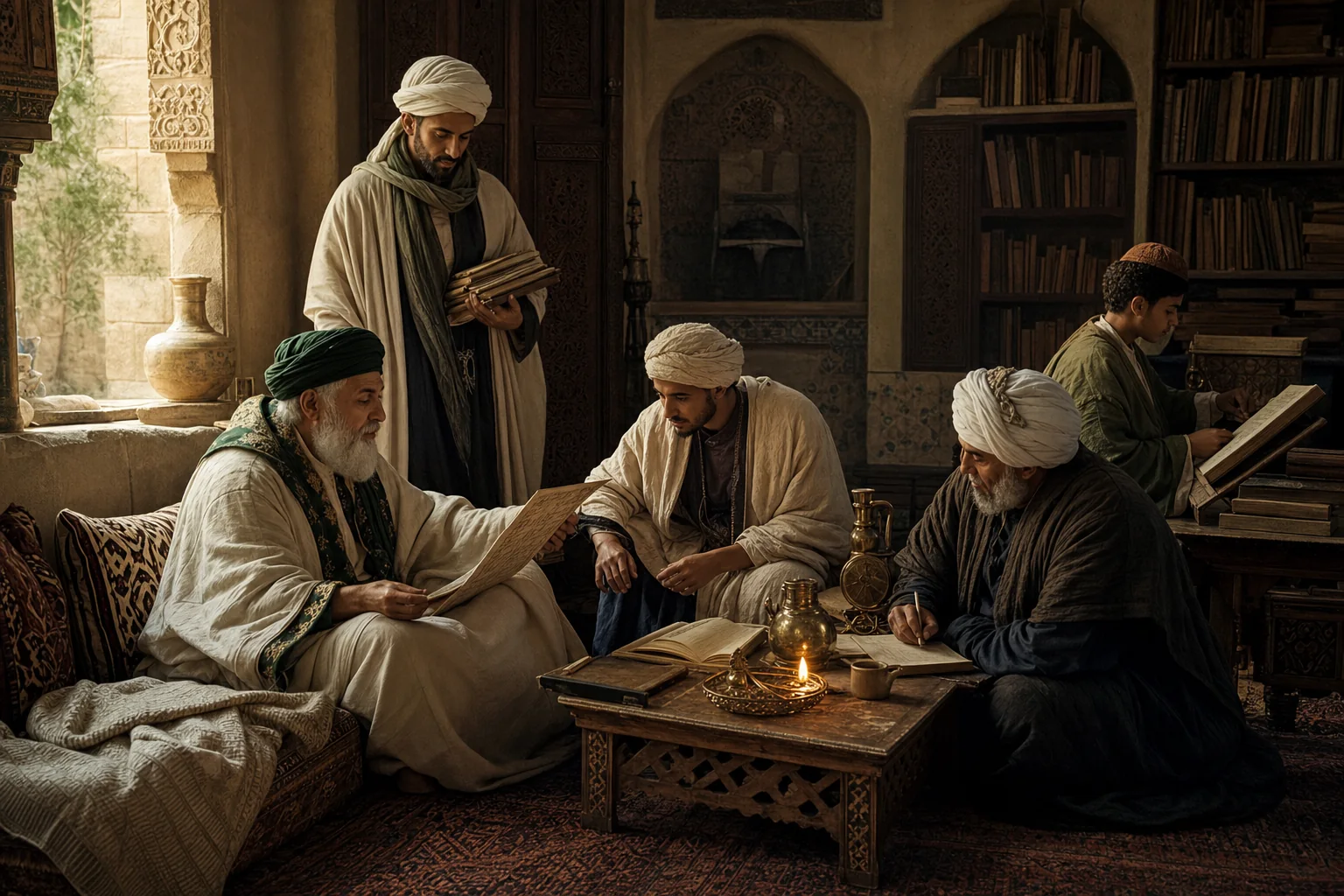
7 min readOriginal interpretive reconstruction created for Druze Bloodline; not an archival photograph.
In brief
Four things to carry forward
The Druze call arose in the intellectually fertile Fatimid capital under al-Hakim.
Hamza ibn Ali organized a theology centered on Tawhid and an esoteric reading of revelation.
The call closed to converts in the eleventh century, turning descent and community memory into central carriers of identity.
The Epistles of Wisdom preserve an internal record whose guarded transmission parallels the thesis of protected knowledge.
1. The Fatimid setting
A capital built for ideas
Cairo was not a remote birthplace. The Fatimid capital joined palace, mosque, library, trade routes, and philosophical debate. Ismaili thinkers read scripture on outward and inward levels, creating a language in which history could carry a hidden meaning without ceasing to be history.
Within that world, the Druze call gathered around al-Hakim and was systematized by Hamza ibn Ali. Tawhid meant more than a doctrinal statement: it demanded unity of truth, ethical discipline, and recognition that appearances alone do not exhaust reality.
2. A boundary becomes a vessel
The decision to close
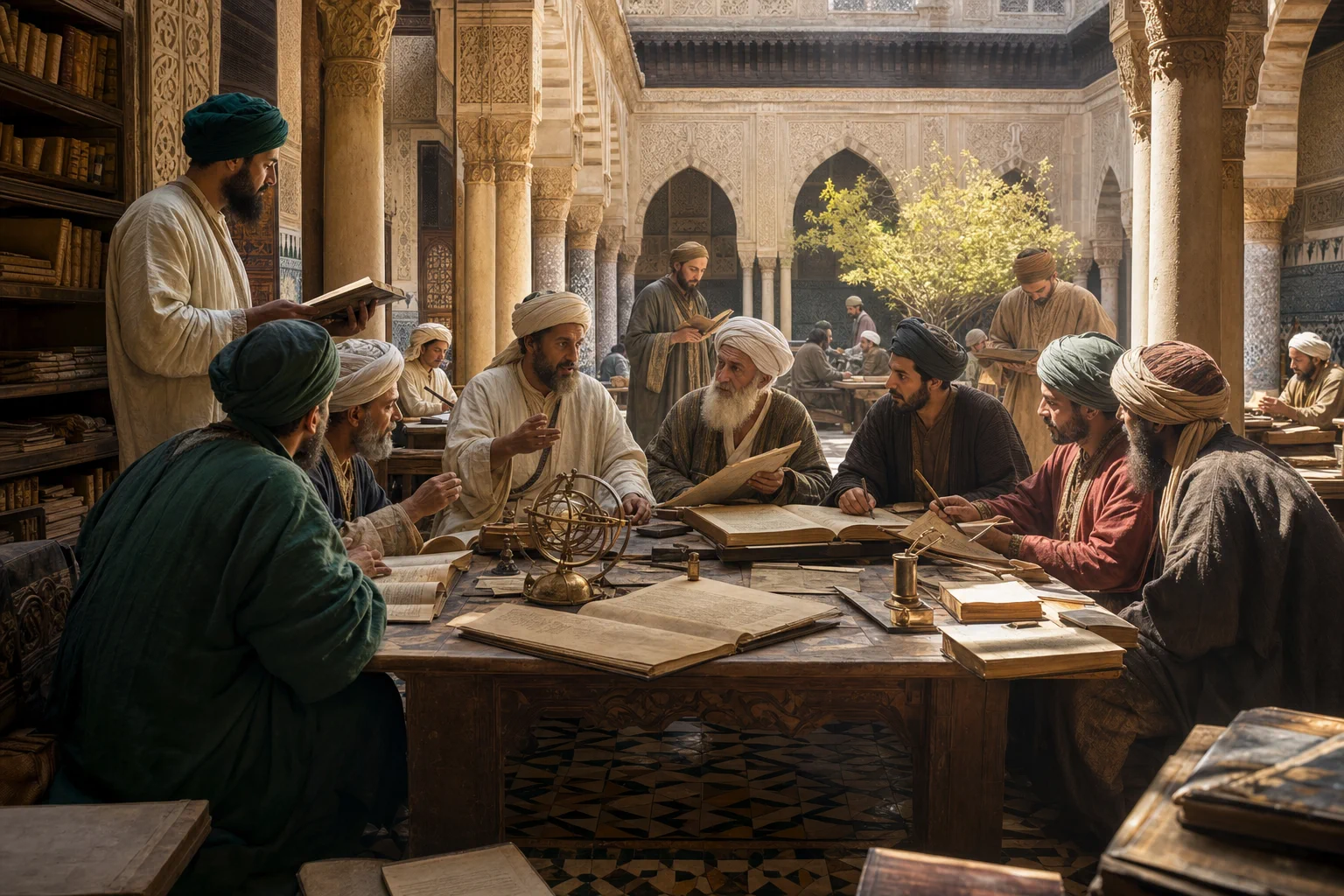
After a brief missionary period, the call closed. No conversion into or out of the faith would define the community thereafter. Mainstream history reads this as a response to persecution and consolidation. The bloodline thesis sees an additional consequence: a bounded population capable of preserving both teaching and descent over very long spans.
That does not make Druze ancestry uniform. Families from several Levantine backgrounds entered before closure, and local communities later developed their own founder effects. Yet the boundary created a rare historical laboratory—one in which belonging, marriage, land, and memory reinforced one another.

A closed door can be read as exclusion; it can also be read as an ark.
3. Knowledge kept in layers
The Epistles as memory technology
The Epistles of Wisdom organize theology through letters, ranks, allegory, and ethical instruction. Access has traditionally been concentrated among initiated religious members, the uqqāl, while uninitiated juḥhāl participate in communal life without the same textual role.
For the lineage inquiry, this structure matters because it demonstrates a living method of selective preservation. A community can carry knowledge across political collapse without displaying every layer to outsiders. That historical fact does not prove a Jesus-line tradition, but it makes the proposed mechanism less abstract.
Evidence desk
Keep each layer visible
Historical thread
Fatimid emergence
Lineage thesis
Closure as guardianship
Interpretive bridge
Motive remains layered
Source notes
Read the underlying record
Fatimids
Background on the Fatimid intellectual and political world in which the Druze call emerged.
Encyclopaedia IranicaIsmaili History
Context for al-Hakim, esoteric interpretation, and early eleventh-century Cairo.
Encyclopaedia IranicaAbout the Druze
A community account of Druze history, values, and the five colors: green, red, yellow, blue, and white.
American Druze FoundationDruze Heritage: Foundation, Community, and Culture
A community and scholarly symposium on a thousand years of Druze history, memory, and global continuity.
Library of Congress