
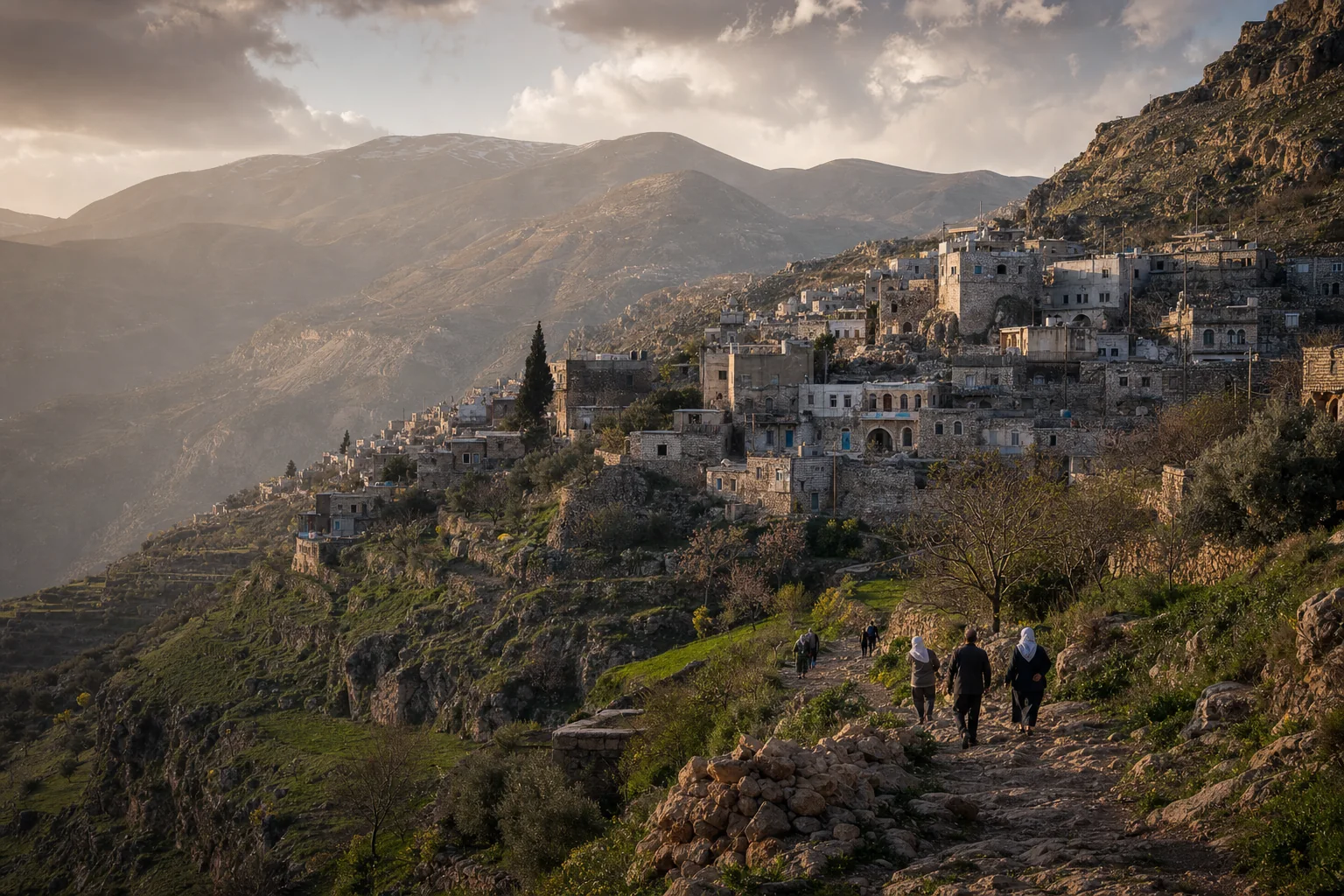
Chapter 03 · Hermon · Lebanon · Hawran
Mount Hermon and sacred geography
The Druze mountain corridor overlaps one of the ancient world's most symbolically charged landscapes: Hermon, the Watchers, Damascus, and Galilee.
8 min readOriginal interpretive reconstruction created for Druze Bloodline; not an archival photograph.
In brief
Four things to carry forward
Druze communities took root in a connected arc from Galilee and Mount Lebanon through Hermon to Jabal al-Druze.
First Enoch names Mount Hermon as the place where the Watchers bound themselves by oath.
Some New Testament scholars consider Hermon a plausible location for the Transfiguration.
The lineage thesis reads this overlap as sacred geography: refuge positioned on an older corridor of revelation.
1. The mountain network
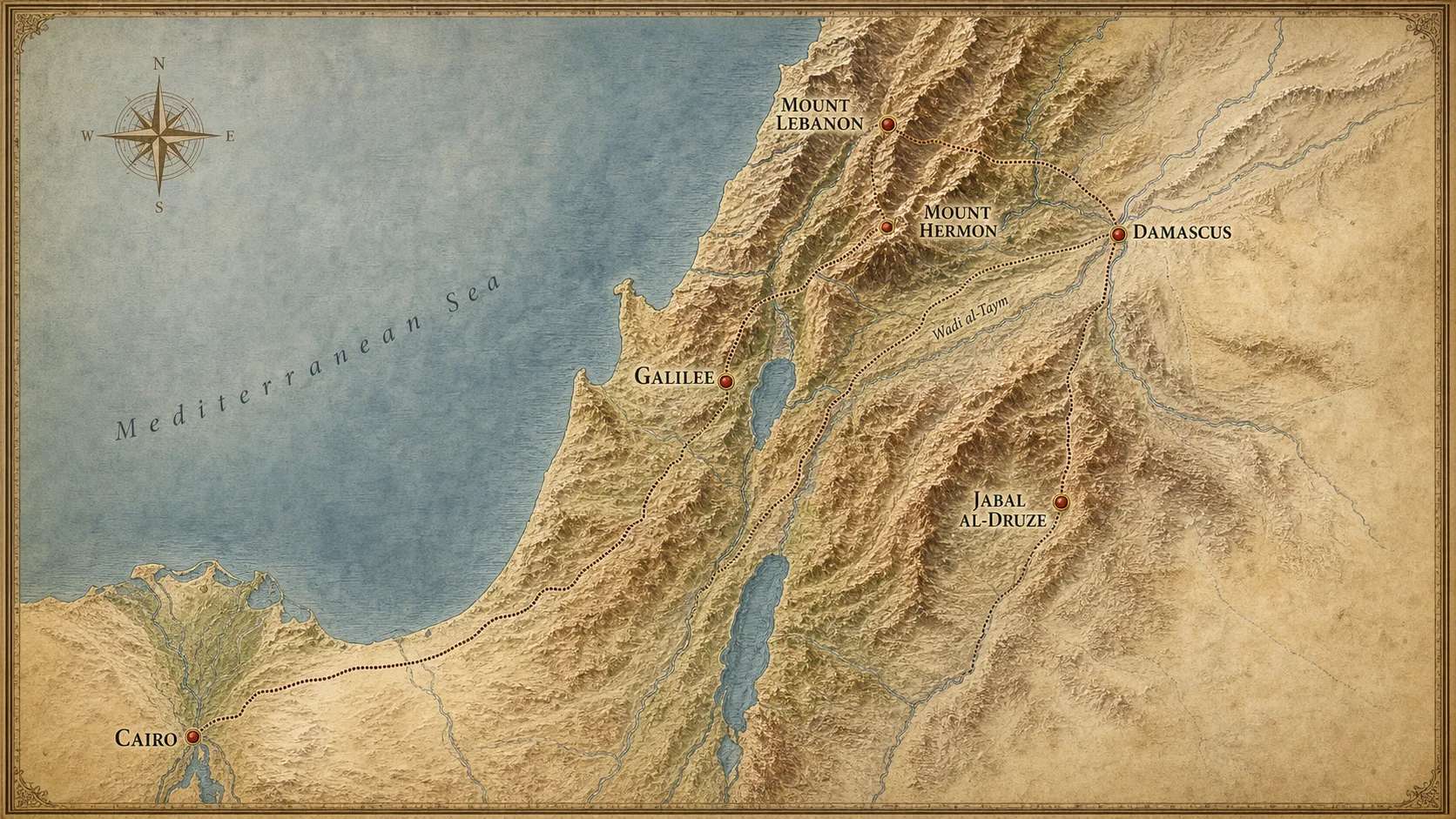
A corridor, not an island
Druze geography is often described as scattered enclaves, but the map reveals a corridor: the Galilee hills, Mount Lebanon, Wadi al-Taym at Hermon's western foot, Damascus routes, and the volcanic plateau of Jabal al-Druze. Families, teachers, traders, and fighters moved through this terrain while imperial borders changed around them.
Mountains offered defensible settlements and a degree of local autonomy, yet they were not isolated from the sacred centers of the Levant. Jerusalem, Galilee, Caesarea Philippi, Damascus, and the northern routes were all within the larger cultural horizon.
2. First Enoch's mountain
The oath on Hermon
First Enoch places a decisive scene on Hermon: heavenly Watchers descend, swear a collective oath, and transmit forbidden knowledge. Whether read as history, theology, or encoded cultural memory, the text gives this specific mountain an ancient role in the passage of knowledge between worlds.
The Gospels later place Jesus near Caesarea Philippi before the Transfiguration. Mount Tabor is traditional, but several scholars argue that nearby Hermon better fits the narrative geography. For bloodline researchers, the convergence is striking: an ancient oath mountain, a possible revelation mountain, and long-lived Druze communities clustered around its slopes.
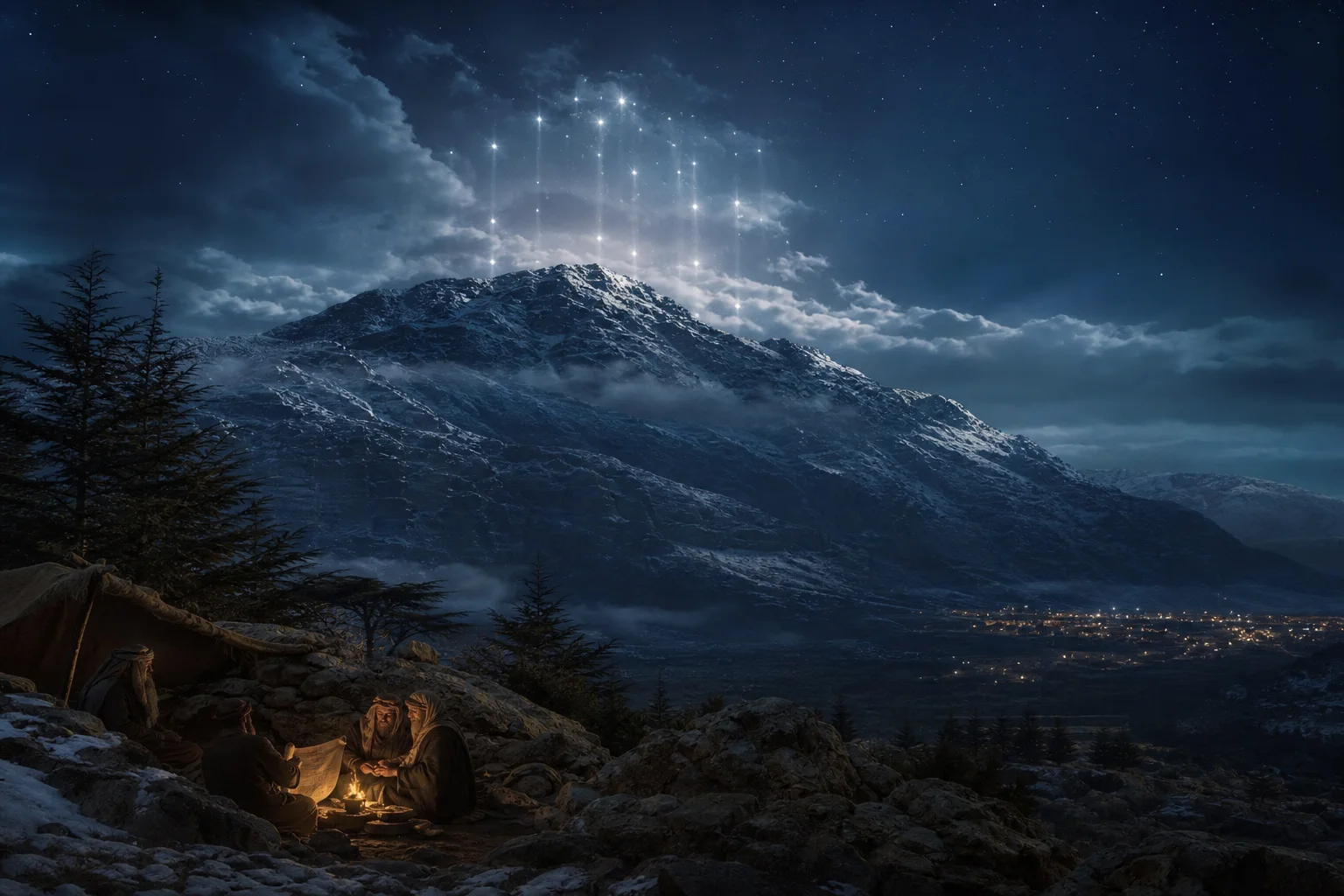
Hermon is not merely scenery in these texts. It is where knowledge crosses a boundary.
3. Place can preserve memory
Sacred geography as a carrier
Lineage is usually imagined as a list of names. In the Levant it may also be a chain of places—shrines, springs, passes, villages, and family houses that keep a story stable when written archives are destroyed. Druze reverence for figures shared across Abrahamic traditions strengthens this geographic memory.
The thesis does not require every ancient event to have occurred exactly as later texts describe. It proposes that communities can remain near charged landscapes because those landscapes encode identity. Hermon's importance is therefore cumulative: textual, geographic, communal, and strategic.
Evidence desk
Keep each layer visible
Historical thread
Mountain continuity
Textual thread
Hermon in First Enoch
Interpretive bridge
Revelation and refuge
Source notes
Read the underlying record
The Book of Enoch, R. H. Charles translation
The influential ancient work that places the Watchers' oath on Mount Hermon and develops themes of guarded knowledge, judgment, and remnant.
WikisourceThe Transfiguration and Mount Hermon
A scholarly argument for Mount Hermon as a plausible setting for the Transfiguration, based on the Gospel sequence and the Caesarea Philippi region.
HTS Teologiese StudiesDruze Heritage: Foundation, Community, and Culture
A community and scholarly symposium on a thousand years of Druze history, memory, and global continuity.
Library of Congress