
Chapter 07 · Names · faces · crossings
The Lincoln–Kahlooni file
A provocative identity map links the Lincoln family to Druze and anticolonial figures through resemblance, names, dates, and proposed transfers across continents.
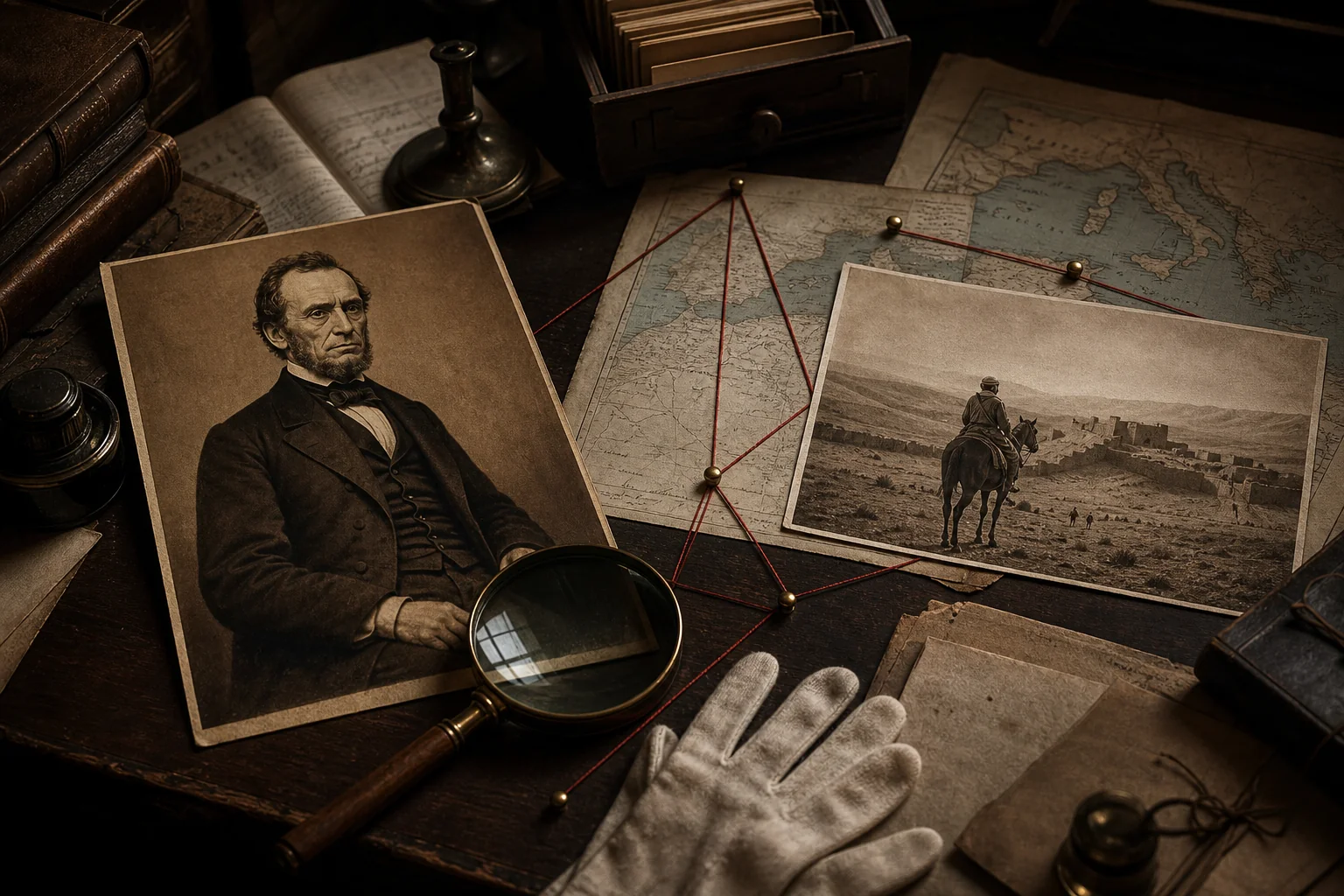
10 min readOriginal interpretive reconstruction created for Druze Bloodline; not an archival photograph.
In brief
Four things to carry forward
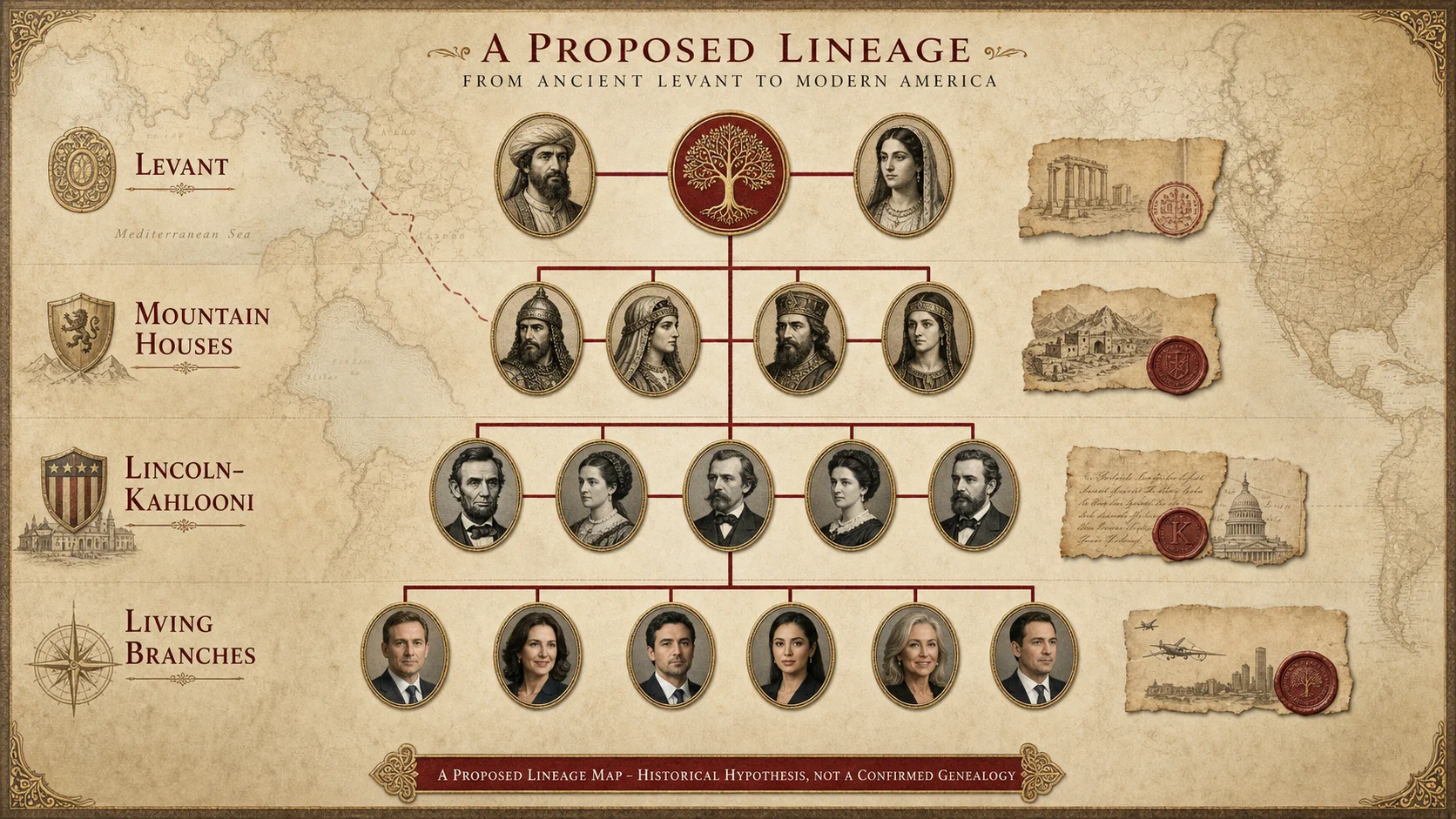
The proposed chart connects Lincoln, Kahlooni, Mukhtar, and later political families as branches of one protected line.
Facial resemblance and name similarity are treated as locating signals, not sufficient proof by themselves.
Contemporary Lincoln records create fixed dates that any identity-transfer theory must explain in detail.
The strongest next step is a document-by-document bridge: custody, travel, education, correspondence, and DNA.
1. A genealogy of hidden identities
Reading the proposed map
The Lincoln–Kahlooni file argues that familiar biographies conceal a transnational family network. Names such as Kahlooni are read beside Lincoln; photographs are compared across generations; deaths and disappearances become possible transfer points; Druze and resistance leaders appear as public identities adopted by protected heirs.
This is a maximal claim, but it has an internal method. The chart expects physical resemblance, repeated naming patterns, historically possible travel, shared political function, and symbolic recurrence to cluster around the same people. Its value is that it makes predictions that archives can test.
2. The most demanding proposed crossing
Willie Lincoln and Omar al-Mukhtar
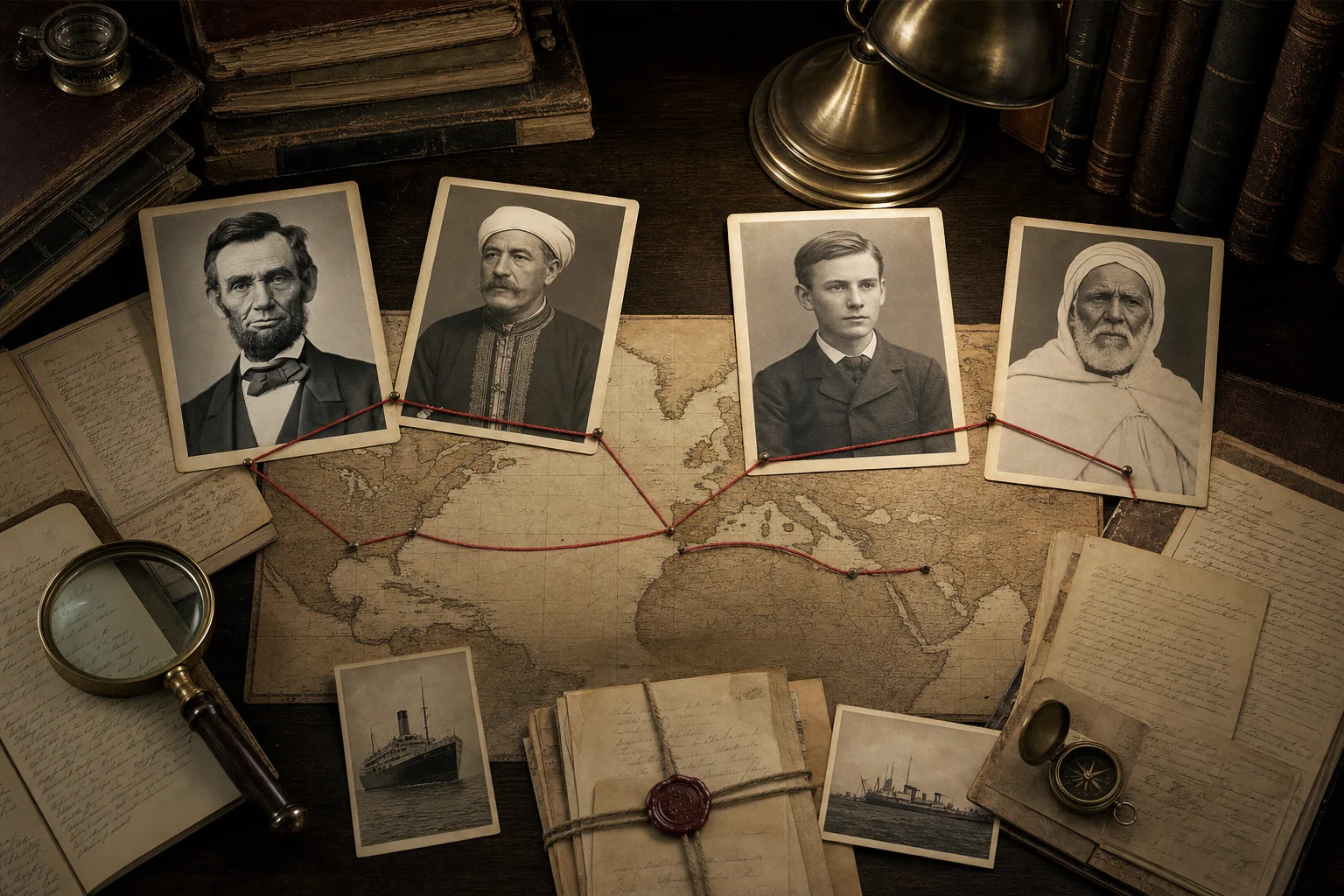
One proposed strand identifies Willie Lincoln, recorded as dying in the White House in 1862, with the future Libyan resistance leader Omar al-Mukhtar, generally dated to an 1858 birth in Cyrenaica. The visual and heroic parallels draw attention, but the conventional timelines overlap rather than align.
Supporters answer that official identities and death records are precisely what a protected transfer would manipulate. That makes independent custody and travel evidence essential. A school register, family letter, diplomatic note, photograph with secure dating, or genetic link would carry far more weight than resemblance alone.
The bolder the identity claim, the more specific the missing bridge becomes.
3. A protocol for identity claims
How to investigate without losing the signal
Start with a dual chronology. Place every documented sighting, age, location, family relationship, and photograph for both identities on one line. Mark what comes from a contemporary record, a later memoir, or an undated image. Then seek moments where the people must demonstrably coexist.
Next examine names in their original scripts, not only English sound. Finally, use facial comparison as a generator of questions, not a verdict. If multiple independent categories converge—especially records or DNA—the file strengthens. If they do not, individual links can fall away without collapsing the larger Druze continuity thesis.
Evidence desk
Keep each layer visible
Lineage thesis
A transnational identity network
Historical thread
Fixed archival dates
Interpretive bridge
The custody trail
Source notes
Read the underlying record
The Lincoln–Kahlooni Druze Minority Bloodline: The Jesus Strand
The principal public chart of the proposed Druze, Kahlooni, Lincoln, Mukhtar, and Kennedy relationships. It is read here as a map of the thesis and a guide for further archival work.
Humorous MathematicsJesus Strand
A complementary presentation of the identity parallels, names, dates, and family connections that make up the lineage argument.
Tap Into The TruthAbraham Lincoln
A federal profile of Lincoln's documented family, public life, presidency, and death.
U.S. National Park ServiceWilliam Wallace Lincoln death record
A contemporary record from the Lincoln papers. In the lineage inquiry it is a fixed point against which any proposed identity transfer must be tested.
Library of CongressReligion as Resistance: Negotiating Authority in Italian Libya
A scholarly history of resistance in Italian Libya and the religious world of Omar al-Mukhtar.
Oxford Academic